Part I
Part II
We’re back scouting the 2026 dynasty rookie wide receiver class. While at this point we’ve discussed the players I would consider likely to go in the first round, there is still a deep cadre of receivers who are vying to hear their names called in the second and third rounds of the NFL draft.
Today, I’ll be discussing three such players, Germie Bernard, Elijah Sarratt, and Omar Cooper Jr, with an eye towards fantasy football scoring and dynasty value. I’ll break down how each player wins, and how I’m valuing them for dynasty.
Fantasy-Relevant Traits
Intermediate Usage
Germie Bernard is a zone-beater all day. He compensates for his lack of explosiveness in his breaks with crispness and suddenness in and out of them. While I doubt his 40 time will impress anybody, his pacing on his routes is excellent, meaning that he plays faster when it’s time to make a cut.
Bernard’s route running tells a story. On most of his routes, he’s running much slower than his actual top speed, because he knows that’s not his game. Instead, he hides his intentions well as he gets into his stem, pacing his route conservatively to go slow-to-fast once he reaches the right landmark. At that point, he’s more quick/sudden than fast, but he consolidates his initiative into a throwing window.
Alabama knew what they had in Bernard and used him frequently on zone-beating concepts. He did a lot of damage in the intermediate areas on dig routes underneath the space that other receivers opened up by running deeper routes. At first glance, Bernard may look really slow when he’s pacing his route, but really he’s average, with a good sense of timing and spacing to let the concept develop.
As far as weaknesses, I’ve already hinted at the athletic limitations, but let me phrase this explicitly. Bernard does not strike me as a future man coverage beater. He doesn’t have the best ball skills in traffic or in contested situations, and corners can mirror him aggressively because they don’t have to respect his ability or willingness to beat them deep.
As far as ball skills go, Bernard sometimes makes bad decisions on how to attack difficult balls. I’ve seen him try to compensate for a lack of body control by one-handing balls that would have been more catchable with a leap and a two-handed attempt. Other times, I’ve seen him try to basket catch balls around his shoulders instead of just plucking them with his hands.
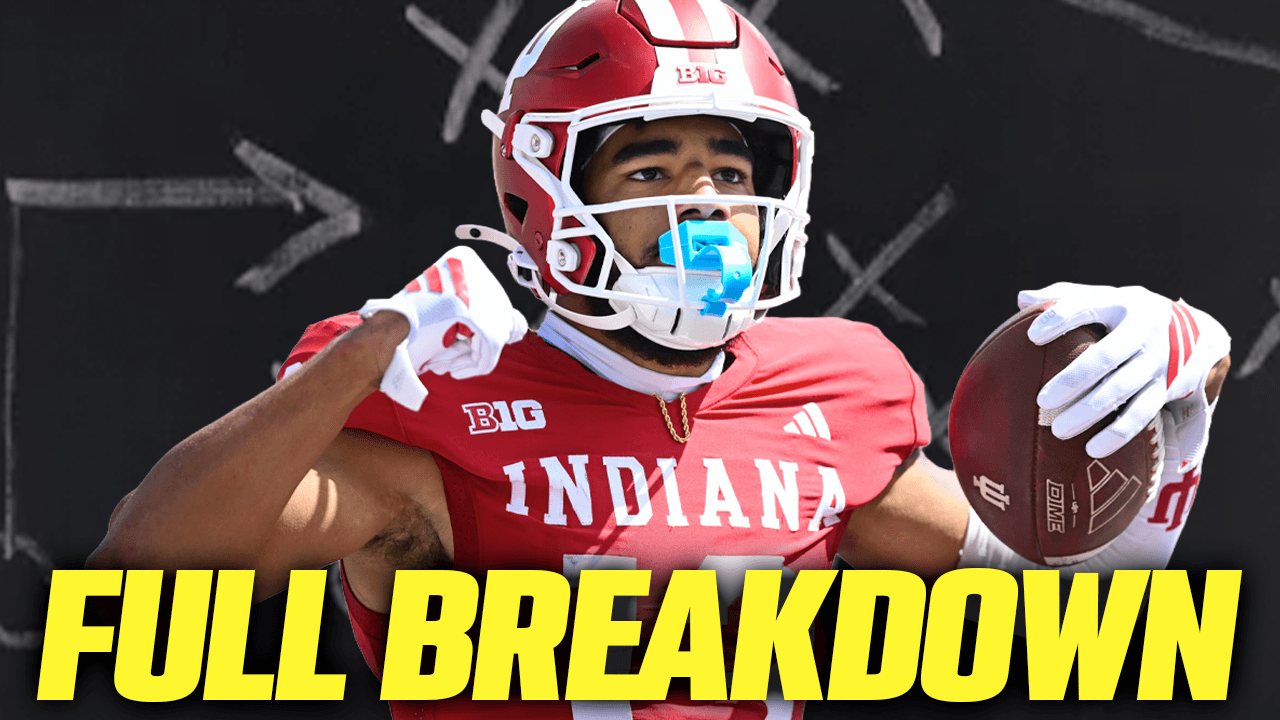
Pivoting over to Elijah Sarratt, he too shows some solid zone instincts. I’ve seen him identify and work to holes in zone coverage after his route initially took him into no man’s land. He likewise knows when to sit and box out so that Fernando Mendoza can throw into his leverage.
Sarratt additionally brings much better ball skills to the table than Bernard. He famously had outstanding chemistry with Mendoza on back shoulder balls, which frequently resulted in chunk plays in the intermediate parts of the field down the sideline. He has good hands away from his frame, but is missing some of the physical gifts to be truly elite in contested situations.
Unfortunately, Sarratt is not sudden in his breaks, which severely hinders his case to be one of the lower-separation receivers who break the mold and earn a large target share. He really struggles to plant and explode on horizontally breaking routes.
There were too many times Sarratt was first in the progression, but failed to win quickly, which resulted in the pass rush having enough time to reach Mendoza. When out-leveraging the corner, he moves well enough to consolidate the advantage and earn a target, but he really labored to get away from sticky corners.
In Omar Cooper Jr.’s case, he’s truly excellent at one specific nuance, namely using head fakes to get corners to flip their hips the wrong way, and then attacking their blind spots. It’s truly impressive how consistently he can use this technique to take the initiative in his breaks. He also has efficient footwork in his releases and hides his intentions well.
My biggest problem with Cooper, however, is that corners can get back into phase with him too easily. He just is not explosive out of his breaks, lacking the ability to plant and cut off one leg. So while he’s very good at taking the initiative, he has serious trouble consolidating that into an open target.
A lot of his receptions came simply because the corner was leveraged wrong, but those times corners played him straight and simply tried to mirror him, Cooper didn’t have answers. He’s also disrupted by physicality too easily at the top of his stem.
It’s admirable the kind of season Cooper put up while overcoming some of these physical deficiencies, but in the NFL, he’s simply going to be an easy cover for average-or-better corners.
For his part, Cooper flashes great hands to make plays for Fernando Mendoza. We’ve all seen his game-winner against Penn State https://www.youtube.com/watch?v=iNHNs-VXtUY, but his hands are on display in other games too. I will say, while Cooper has a knack for the spectacular, there are also times he has a chance to bring in tough, but not terrible, throws that he doesn’t. Those are plays you’d like to see made a bit more consistently to really project a receiver as having all-around elite hands.
Short Usage
In the short areas, all of Bernard’s advantages against zone shine even more. Listed at 6’1”, Bernard has good size to out-leverage corners who are closing late. Granted, I would like if he held on through contact better.
Between his size, his zone-beating chops, and a lack of success separating from man coverage corners, Bernard profiles best as a big slot type of receiver, which may be cliché, but it fits him perfectly.
Sarratt is also generally very adept in the short areas of the field. I do wish he won on slants a bit more consistently, but he’s great at bringing in tough catches through contact and in traffic. He’s physically strong, and throws into his leverage are quite reliable.
Omar Cooper Jr. unfortunately has slightly worse zone instincts than Sarratt, and he’s not built quite as sturdily, so his leverage isn’t too reliable to throw into. While he’s listed at 6’0”, he seems to have a smaller catch radius than Sarratt, and Mendoza had more trouble hitting him on timing routes.
Run After Catch
These situations are really the only times you see Bernard open up and hit his top speed, which is respectable but nothing to write home about. He has good vision as a ball carrier and some contact balance to break the first tackle, to go with good smoothness to glide laterally and find running lanes. He’s not the type to earn screens in the NFL, but he can definitely squeeze eight yards out of a sliver of a rushing lane.
Sarratt is less elegant but no less effective than Bernard. He doesn’t really have the speed or change-of-direction of most receivers, but he’s tough as nails and tends to keep on trucking out of pure spite while defensive backs are trying to bring him down. Sarratt breaks the first tackle attempt with surprising regularity, and can really make some corners look bad if they don’t wrap up.
Omar Cooper Jr. received a good share of screens while at Indiana, and he executed them just fine, but I don’t foresee him earning screens at the NFL level. He just doesn’t move like a playmaker in space.
Deep Usage
Without sugarcoating it, none of these receivers produce behind the defense. Of this group, Omar Cooper Jr. is the most effective because he runs an extremely nuanced post and corner route. He uses that headfake of his to disguise his intentions and get corners to bite the wrong way. Additionally, his footwork is quite efficient in his release, often helping him win early in the rep.
Unfortunately, even with an early edge in his release, it’s too easy to make up ground on Cooper. For this reason, he won’t add much value on deep routes. NFL corners will have way too much makeup speed to get back into phase with him.
In Sarratt’s case, he was essentially never asked to get open deep down the sideline, with Fernando Mendoza instead preferring to throw him back-shoulder balls. I lumped that into his intermediate production, but suffice to say, he’s not really getting behind the defense.
In Bernard’s case, he has a decent release and throttle, but he was rarely targeted behind the defense. This simply isn’t the bread and butter for any of these receivers.
Traits That Matter for Earning a Role
Hands (Reliability)
Germie Bernard had a habit of basket-catching balls that he should have been plucking, and at times struggled in traffic. His drop rate is technically low at only 5%, but as a zone beater in the short and intermediate areas, he’d ideally make catches on some of these balls that don’t technically count as drops.
On the other hand, Elijah Sarratt and Omar Cooper Jr. have outstanding hands. Sarratt rates better in terms of catching through contact, having more reliable leverage, and jostling for position. Meanwhile, very few players in this class can match Cooper Jr. for his knack for making highlight reel catches on difficult balls.
Blocking
I quite liked Germie Bernard’s blocking. He handles physicality well and seems to block with good pad level. This further helps him project favorably as a big slot.
Omar Cooper Jr. tends to shirk blocking responsibilities, except if he and a corner are starting to get chippy with each other. Then we sometimes see him hate-block his man. I’d argue he disrupts the man he’s blocking more frequently than Sarratt, at least.
Overall
Germie Bernard
Bernard’s value for dynasty will depend heavily on his landing spot. Ideally, he is drafted somewhere to complement an elite X receiver, with opportunities to play both some slot and flanker.
I have a lot of trouble valuing Bernard. On the one hand, the dynasty community underestimates the importance of zone-beating, both in terms of being a real-life good player in the NFL and in terms of being a consistent fantasy scorer. On the other hand, I’m not sure I’ve ever seen a prospect quite as min-maxed towards zone beating as Bernard.
For Bernard to take off for fantasy, he’ll need a coaching staff that’s bought in on him as a full-time player who beats zones for them. However, Bernard is missing some of the other traits that would make him deserving of a featured role.
To start, his hands just aren’t quite as reliable as I’d like them to be. While his raw drop rate is low, there are too many balls that your big slot receiver should come up with that he doesn’t. Whether it’s finishing through contact, adjusting to high balls, or plucking balls away from his frame, he’s simply not doing enough of the extra things to be featured.
If I had to take a shot on some player drafted in the third round or later to beat the odds and become a fantasy asset, it would be Sarratt. He lacks some of the athletic traits that would encourage NFL teams target him high, but he really excels at the reliability aspects of the game.
So often, wide receiver is a reliability position masquerading as a finesse position. In Sarratt’s case, if he continues winning with physicality, catching everything, and being an “easy” button for his offense, he could earn playing time early while his game rounds out.
However, I can’t go so far as to tell you Sarratt deserves to be a second-round pick or higher in the NFL draft. I worry there is too much tweener to his game. With his movement ability and the way he wins, he essentially needs to play X receiver. However, he would be one of the worst-blocking X receivers in the league until his technique improved. That doesn’t exactly scream “rookie year breakout”.
The vision for Sarratt is that his physical play style and tenacious attitude takes well to coaching in training camp, and he cleans up the more fixable aspects of his blocking technique in a hurry. In this case, he could earn the trust of his quarterback through sheer reliability as early as training camp.
Omar Cooper Jr.
Cooper Jr. is a really good football player whose skills and talents most likely won’t overcome his athletic limitations at the NFL level. It’s genuinely impressive how deceptive he can be at the top of his routes; he’s efficient in his releases, and he has some really impressive hands.
Unfortunately, Cooper Jr. doesn’t have the physical traits to consolidate an advantage against NFL corners. He is neither fast overall nor explosive out of his breaks, so even if he gets an early advantage, corners can recover to him and stay in phase. He’s not as physically sturdy as Sarratt, and as far as I can tell, his catch radius is smaller, which means corners can play the ball even if they’re recovering to him a little late.
I won’t be targeting him in fantasy drafts except as a late dart throw, but I’m absolutely rooting for his nuance and pluckiness to prove me wrong.