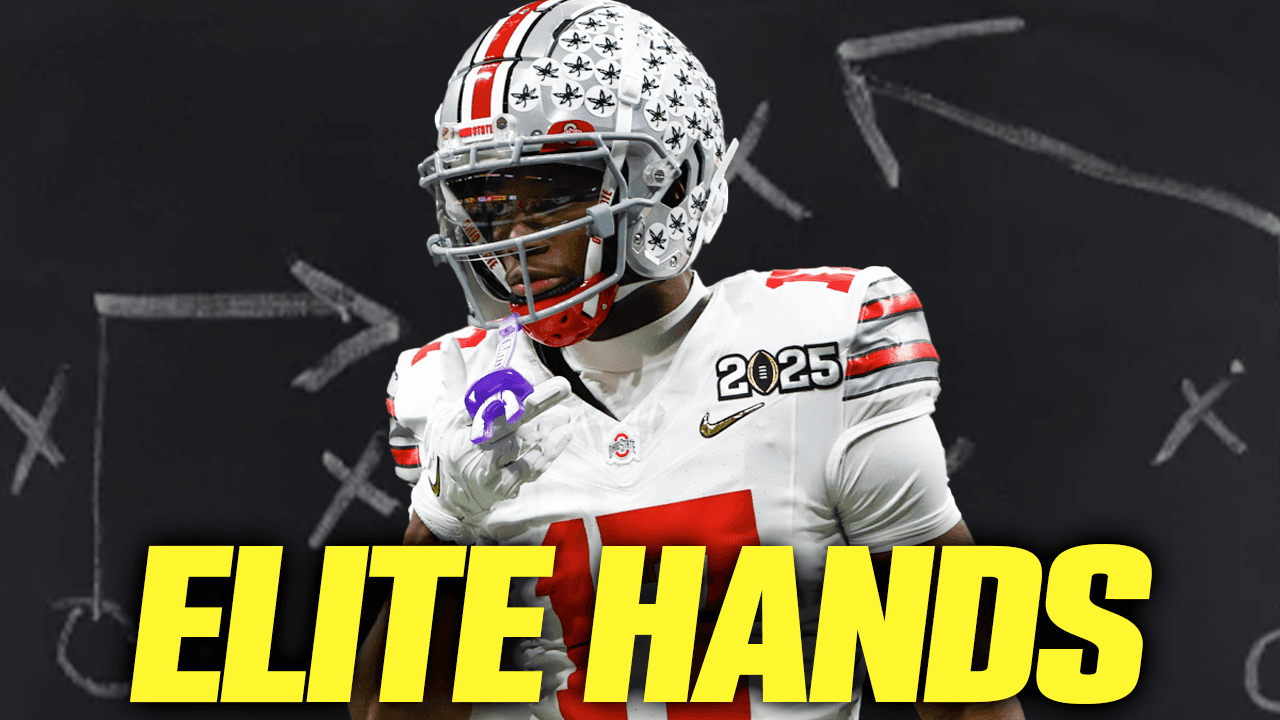
Much like the 2026 quarterback class, a consensus has formed around which players make up the “big three” wide receivers in this year’s draft class. Arizona State’s Jordyn Tyson, USC’s Makai Lemon, and Ohio State’s Carnell Tate should all hear their names called in the first round of the NFL draft, and most likely early.
Today, we’ll go through several traits crucial to the wide receiver position and judge how each player stacks up in each category. We’ll break down how they win and what they could stand to improve on. Then, I’ll explain how these players rank for me overall, and why.
Route Running
Makai Lemon is without a doubt the best route runner in the class. He moves like he was born to play wide receiver. Lemon changes direction crisply and fluidly, cutting on a dime. He beautifully combines natural agility with efficient footwork.
For his part, Carnell Tate can’t get around a field as quickly due to his size, but he is the farthest thing from a static contested catch guy down the boundary. Ohio State asked him to beat defenses over the top and over the middle. He changes speeds effectively and uses his head and shoulders to get defensive backs leaning the wrong way.
Tate’s speed and agility might not be as great as Lemon’s, but for his size, it’s very good. He’ll never be the type of player to instantly dust a man coverage corner, but he can also get his. With Tate’s speed and size, you need to be leveraged correctly to have any chance of covering him, and if you let him get a step, he has just enough speed to consolidate the advantage without getting caught up on easily.
Jordyn Tyson’s route-running disappointed me a little. To be fair, he’s played a ton of games banged up at this point, so it’s hard to know what his 100% looks like.
Don’t get me wrong, Tyson moves extremely well, especially at an alleged 6’2”. He’s naturally explosive and fluid. However, he does not change speeds or hide his intentions well against man coverage. The end result is that corners jump his routes and stay in his hip pocket.
While Tyson could very well be the best athlete of this group, and he’s far from just an athlete, he runs all his routes at one speed, and he telegraphs his cuts. The end result is that the athleticism plays down, especially compared to somebody like Lemon whose athleticism plays up.
Ability Against Zone Coverage
While I was somewhat harsh about Jordyn Tyson’s route running, I actually really like his instincts against zone coverage. He knows when to sit in the soft spots, and he has a good sense of how to make minor adjustments to keep his spacing between the defensive backs around him.
Beating zone coverage is often more important than beating man coverage at the NFL level, so teams will be happy to get production out of Tyson against zone while teaching him the finer points of route running. If he learns some route-running nuance to go along with his natural movement ability, the sky is the limit for him.
Makai Lemon also shows solid fundamentals against zone. He works hard to keep moving into the next window rather than letting his route take him behind an underneath defender. Additionally, he makes tough catches look routine and rewards his quarterback for fitting the ball to him through a tight window.
Carnell Tate was asked to run a ton of deep routes, digs, and crossers, which meant he wasn’t really sitting in the short-intermediate parths of the field very often. However, his leverage and hands are so reliable that he projects favorably in this facet when he makes the jump to the NFL. We just can’t take it for granted.
Hands
Carnell Tate has the best hands in the entire class. Not only has he not dropped a pass all year, but he’s a hands-catcher who plucks the ball out in front of his frame. Combined with his arm length, it is incredibly hard to play the ball through his leverage.
Additionally, Tate is extremely effective deep down the field because defensive backs have no shot at disrupting him if he has a step on them. He high points the ball well and reels it in reliably. This means it’s nearly impossible to reach as high as Tate if you’re a little late and have to jump diagonally to get to his zenith. He rewards quarterbacks even if they slightly underthrow him deep down the field. His concentration is also outstanding in these situations.
For his part, Makai Lemon plays way above his size thanks to his hands. He wins 50/50 balls against bigger defensive backs and makes adjustments to reel in tough catches regularly. This will be crucial for him at the NFL level.
Even for good route runners, having a small catch radius makes a big difference. Somebody like Elijah Moore comes to mind. When lined up as an outside receiver, he left plays on the field because getting a step against his defender wasn’t enough. It was too easy to recover into his small catch radius.
Lemon on the other hand is very quarterback-friendly. He makes his catch radius artificially bigger by reacting, adjusting, and leaping to bring down tough passes. If he becomes a star player, it’s because this element helped him succeed as a downfield target who can line up outside in addition to getting slot work.
Jordyn Tyson is unfortunately more of a body-catcher, which tends to translate badly to the NFL level. I also saw him struggle to reel in balls that were slightly off his frame. While he can make really good catches at times, this is a facet where consistency is king.
Run After Catch
While nobody in this top three is a truly great creator in run-after-catch situations, Makai Lemon is the best of the bunch. He’s really shifty, often planting and giving the impression he’s zigging before zagging. He also wins more with grit and strength than you’d necessarily expect given his diminutive stature.
Jordyn Tyson is a naturally explosive player who can eat open field in a hurry, and he has some make-you-miss in screen situations, but I don’t consider his run after catch to be an elite trait.
For his part, Carnell Tate runs hard but isn’t necessarily shifty enough to make defenders miss and evade tackles. He can be hard to chase down if he gets too much runway, however.
Blocking
While blocking doesn’t score fantasy points, it can determine whether a wide receiver is a situational player versus one who never leaves the field.
Of these three players, the only one who was truly asked to execute non-trivial blocking assignments was Tate. Ohio State sometimes motioned him adjacent to the offensive line and then asked him to seal the edge against a linebacker so that they could run the ball through the gap he was sealing. The effort isn’t necessarily there every single time, but he has plenty of reps on tape where he is blocking his ass off through the echo of the whistle.
Jordyn Tyson has an “on” switch he can turn on when run plays actually go in his direction, and it’s nice to see, but for the most part he was running decoy routes to keep his defensive back busy.
Makai Lemon is too small to execute the types of blocks that Tate did, but he’s feisty as hell, and I like his chances to at least avoid being a negative.
Overall
Currently, I have Lemon and Tate at the top in a tier together, with Tyson in the next tier below them. I worry about Tyson’s reliability making catches away from his frame, which tends to separate star receivers from dudes who are nice to have but who leave plays on the field. Additionally, his route running is more of a projection compared to the other two.
As far as Lemon versus Tate, they’re such different players that it really comes down to personal preference. As a dynasty owner, I might lean toward Tate due to the fear that Lemon could be pigeonholed as a slot-only player.