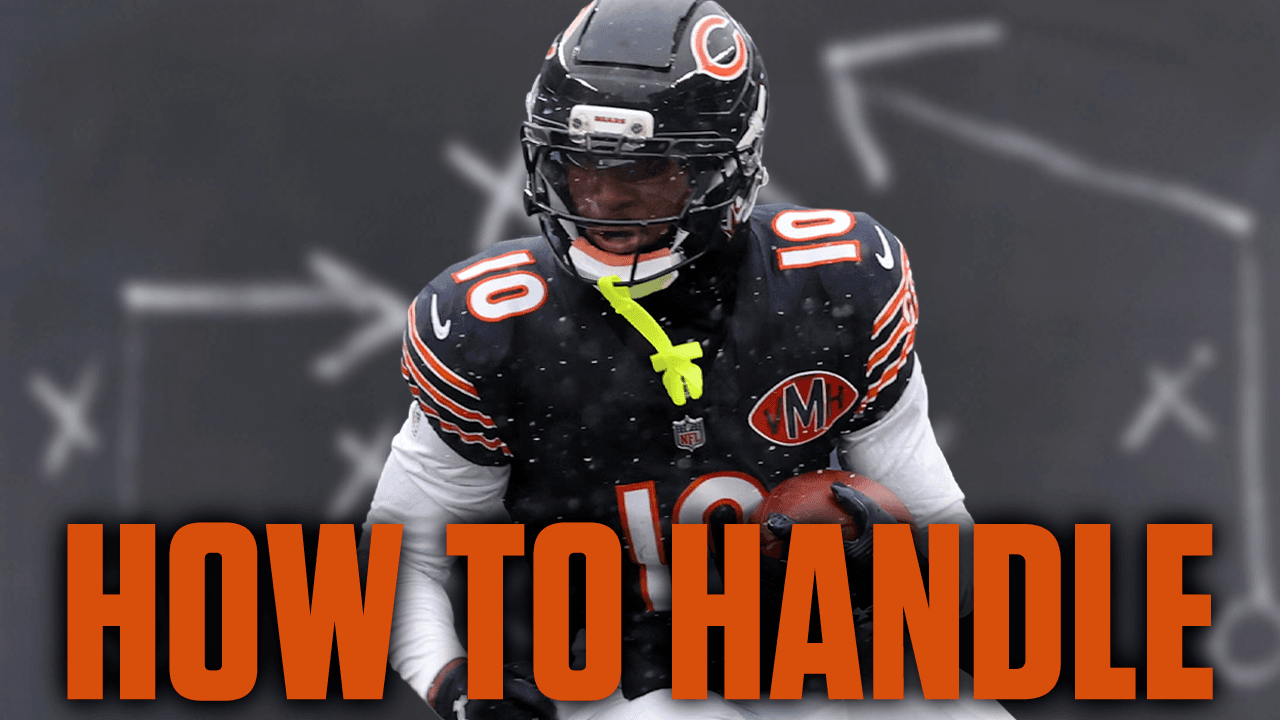
Of all the ambiguous position groups in the NFL, the Chicago Bears’ pass catchers are the most tantalizing. While owners of Rome Odunze, Luther Burden, and Colston Loveland can all justifiably dream of a breakout season for their prized assets, statistically speaking one or more of these players is likely to disappoint.
Figuring out who will rise to the top of the pecking order in Ben Johnson’s passing offense could gift a shrewd owner with the next game-changing dynasty asset, but that’s much, much easier said than done.
To arm you with the information needed to make that determination, today I will take you through the opportunity available in the Bears’ pass-catching group, how each player’s skillset fits into the offense, and what their paths to fantasy stardom look like.
Offensive Environment
Volume
Last year, the volume was there for the Bears’ passing game, but the efficiency wasn’t. Caleb Williams was inaccurate, on tape seemingly inconsistent at all levels of the field. Yes, he can pull off a “wow” throw at any time, but the down-to-down consistency was missing.
Overall, the Bears ranked 4th in the NFL in called pass plays and converted them into pass attempts at a strong rate. Williams was actually only 14th in scramble rate at 6.6% and 4th-best in sack rate at only 3.79%.
However, among quarterbacks with at least 250 snaps in 2025, Williams was a whopping 35th in completion percentage at only 58%. Taken together, Williams was still a respectable 7th in the NFL in pass yards with 3,942. He was also 6th in passing touchdowns with 27.
As a unit, the Bears’ offense was extremely streaky, and Williams himself was scattershot throwing the ball. Even though the raw counting stats were solid, his pass catchers struggled to put together consistent fantasy performances from week to week.
If we want to be optimistic, we can argue that by baking in some organic development for Williams, this will eventually be a highly productive environment for fantasy football. Pessimists will tell you that, due to the decline in passing volume in today’s NFL, being 6th or 7th in the NFL in output isn’t enough to support a fantasy receiver without efficiency and concentration.
Concentration
Particularly with how passing is down across the NFL, and with how offenses are moving towards two tight end sets, concentration is becoming king. Sam Darnold threw for only 106 more yards than Caleb Williams, yet Jaxon Smith-Njigba reeled in 1,000 more receiving yards than the Bears’ leading pass catchers. Suffice to say, in order to predict who will break out in Ben Johnson’s offense, we absolutely need to figure out whether the targets will consolidate to just a couple of players.
From watching the 2025 Bears’ offense, I’m very worried as a dynasty owner about the target concentration. A whopping seven different players caught 300+ yards last year (ok, I’m rounding up D’Andre Swift’s 299 yards), and this wasn’t just a reflection of the inconsistency of the passing game. As far as I can tell, the flow of the offense genuinely causes this incredibly wide target distribution, even when it’s firing on all cylinders.
Ben Johnson’s offense features a healthy dose of screens and designed targets meant to get pass catchers in space. This included both of the running backs, Olamide Zaccheaus, Luther Burden, and D.J Moore. In addition to the designed underneath targets, I saw plenty of shot plays that were realistically only designed for a single pass catcher, and many more plays whose design required multiple clear-out routes with the first read breaking open underneath.
Even in a world where a single pass catcher outplays the others in 2026, I think this balanced target distribution will remain a huge part of the offense. There is hope, however. Firstly, D.J Moore is no longer on the team, which fast-tracks both Rome Odunze and Luther Burden into 2-receiver sets. For what it’s worth, Olamide Zaccheaus is also no longer on the team, which brings the total of vacated targets up to 150.
In the past, we’ve seen the Ben Johnson offense funnel 140+ targets to his best receiver in Detroit. If somebody steps up, the volume will follow. However, the most likely result is that this offense remains highly fluid, with Johnson dialing up concepts meant to feature several different players, including the running backs, the depth tight ends, and even new signing Khalif Raymond.
Personnel Trends
Last year, the Bears were in 11-personnel around 51.6% of the time, 12-personnel 32.6% of the time, and 13-personnel 8.5% of the time. Since then, D.J. Moore was shipped off to Buffalo, and the Bears drafted tight end Sam Rousch in the third round of the NFL draft.
At this point, the Bears' tight end room looks very strong, while the wide receiver room is led by two unproven players, albeit with great pedigrees and upside. Taken together, I fully expect the offense to shift even more towards 12-personnel and 13-personnel than it did last year.
This could actually represent a huge opportunity for all three relevant pass catchers, as Ryan Heath discussed in great detail over at FantasyPoints. Essentially, Colston Loveland was extremely efficient in heavy personnel looks, and wide receivers who stay on the field in heavy packages tend to be highly efficient too.
With D.J Moore off the roster, and with more blocking tight ends (i.e., mediocre target earners) on the field, the offense should consolidate considerably more around Odunze, Burden, and Loveland.
Ben Johnson’s Slot Receiver
One question on many dynasty owners’ minds is whether somebody will emerge as Ben Johnson’s primary slot receiver. We’ve all seen Amon-Ra St. Brown, and before that Jarvis Landry, break out in part thanks to Ben Johnson, and many of us have heard that quote floating around in which Johnson discusses how he loves to run his offense through the slot.
Based on the history of Ben Johnson’s slot receivers, it’s natural for owners to speculate about which receiver will be the beneficiary of Johnson’s slot usage next season, but I think we have it backwards. I would argue that the causality is not “whoever is Ben Johnson’s slot receiver becomes the most productive”. Instead, I would argue Ben Johnson’s most productive receiver will frequently move inside to create favorable matchups.
It’s really easy to fall into the trap of assuming Luther Burden profiles best as the slot receiver in this offense, but my best guess is that each pass catcher will rotate in and out of the slot until somebody really takes over as the alpha in the room. Let’s think about this from Ben Johnson’s perspective. If you’re Johnson, and one of your core offensive philosophies is that you love running your offense through the slot, would you deploy your second or third-best receiver as the lone full-time slot option? No, you would rotate your best receiver into the slot at a healthy rate.
Just last year, there was a serious slot-by-committee going on in Chicago, with Olamide Zaccheaus and Luther Burden functioning as the primary slots, but with D.J. Moore, Rome Odunze, and Colston Loveland all lining up there too.
Lastly, if the Bears do in fact transition to frequent 12 and 13-personnel usage, the slot receiver role as we know it will change dramatically. In 2025, Odunze and Loveland often aligned in the slot in heavy personnel packages, despite not exactly being Amon-Ra St. Brown clones. Ben Johnson’s offense philosophy is not static, and it will mold around his best players.
Now that we’ve finished discussing the offensive environment, let’s talk about each pass catcher’s role in the offense.
Luther Burden
Role
Early in 2025, Luther Burden took a bit of a backseat while he proved himself by making contributions along the margins. He was involved in special teams, ran a lot of cardio by running clear-out routes to open up space for other receivers, and showed more alacrity blocking than he did in college.
Later in the season, he stepped into a limited but valuable role, seeing the field about 60% of the time with a steady diet of designed targets, consisting mostly of screen and flat routes. He also benefitted from lots of crossing routes at all depths of the field into spaces cleared out by other teammates. In large part thanks to this usage, he was highly efficient, racking up an impressive 2.68 yards per route run.
2025 was ideal in terms of setting the table for Burden. He proved that he was ready to step into a large role, most likely making it an easy choice to dump D.J. Moore. For the most part, he showed the effort that Ben Johnson was looking for, even in a menial role, and he executed the screens and shot plays that were called for him.
From a fantasy football perspective, Burden’s role is extremely enticing. He has a PPR floor as a screen and pop-pass guy, some juice with lots of dialed-up touches in space to generate run-after-catch, and untapped upside as a man coverage beater. And yes, he’ll probably spend the most time in the slot of all the Bears’ pass catchers. Burden doesn’t exactly project to be a priority in the red zone, due to the presence of Rome Odunze and multiple viable tight ends, but he could transcend this as he develops.
Positives
As mentioned previously, his yards per route run were eye-opening, with the notable caveat that it’s easier to put up high efficiency on low volume, and Burden’s YPRR was on only 243 routes run, which was 98th among NFL wide receivers in 2025.
In addition to the yards per route run, Burden put up a solid 25% targets per route run, good for 19th in the NFL. To be an elite fantasy asset, he doesn’t exactly need to maintain his efficiency, either. There is a ton of room for him to simply play more and receive more volume, and his prominence in the screen game and on crossing routes will give him a solid PPR floor.
For dynasty owners who took a chance on Burden last year, he checked every box, even if he didn’t break out all the way. Burden avoided the doghouse, delivered some big plays, and cleared the runway for a big sophomore season.
Negatives
No matter how I massage the data, it’s concerning that Burden didn’t receive more playing time. His highest snap share was 71% in week 14, but it was around 63% down the stretch.
You might be saying, “Well, he was in a crowded receiver room”, but in a week 17 game that both Rome Odunze and Olamide Zaccheaus missed, Burden was even outsnapped by Jahdae Walker (62% to 58%). In the divisional round of the NFC playoffs, he received only a 53% snap share. Granted, he was banged up dating back to when he missed Week 16, and that could mean he was on a pitch count.
As far as I can tell, from Week 17 onward, these injuries were more of the “banged up” variety that essentially every NFL player is dealing with by playoff time, but I don’t need to die on this hill. If somebody more plugged into the Bears knows for a fact he was limited because these injuries were more serious than the Bears’ coaching staff admitted in pressers, I’d happily re-evaluate this take.
Why Isn’t Luther Burden the Slot Receiver By Default
Clearly, Luther Burden profiles the most naturally to the slot. Rome Odunze is built more like an outside X receiver, while Burden is explosive in space and absolutely feasted as a vertical slot in college. As the clubhouse favorite to lead the team in slot snaps, if Burden develops into a stud player, he will absolutely dominate fantasy as an efficient flanker-slot player.
However, before we assume Burden is walking into that role, I need to stress a couple of points. First off, slot receiver tends to be a zone-beating position, and in the NFL, it’s a blocking position too. Amon-Ra St. Brown became a star in large part because he’s psychotically competitive. He gets the details right, catches the ball in traffic, and blocks his ass off. Coming out of college, my biggest concerns about Burden were his effort and instincts against zone, his attention to detail, and his blocking. This is starting to sound less and less like a Ben Johnson slot receiver.
To his credit, I did see solid effort from Burden on tape in his rookie season. Before his playing time increased midseason, he was forced to prove himself by doing the grunt work. Ben Johnson made him pay his dues by blocking and running clear-out routes before he was featured in the offense. Going into year two, Burden needs these lessons to stick in order to earn a full-time role.
Projection
While 2025 set the table for Luther Burden, I would argue that whether he actually takes the next step and becomes a full-service wide receiver requires a lot of projection. Frankly, the offense didn’t ask him to win in isolation very often. Instead, he benefitted from concepts that overloaded defenders’ responsibilities and created the space for him to work.
If we consider the parts of his game where he struggled, they’re all skills that WR1s excel at. Burden left plays on the field, failing to hold on to some tough balls. He was frankly bad working the scramble drill, and he showed a puzzling lack of chemistry with Caleb Williams against zone coverage.
Don’t get me wrong, Burden could absolutely develop all these skills and more. All I’m saying is that for him to become the top dog in his offense, we need to project improvement in several key areas.
The most important variable for Luther Burden’s fantasy production will be his playing time, and his rookie season did leave cause for concern. Make no mistake, Burden had chances to play a full complement of snaps last year, as Rome Odunze missed weeks 14 through 18, and even Olamide Zaccheaus missed Week 17. There was something Ben Johnson was seeing, or not seeing, in practices that made him leery to promote Burden to a full-time role. Whatever that something is, we need Burden to improve on it next year.
Overall, Burden controls his own destiny. As long as he keeps rounding out his game and earning Ben Johnson’s trust, there are no more obstacles between him and a major role. Everything depends on whether he makes the most of this opportunity.
Rome Odunze
Role
Right off the bat, Odunze owners will be happy to know he isn’t being used as some static X receiver who runs cardio and eats the toughest assignments. Ben Johnson is genuinely moving him around the formation, including some slot snaps. He was also clearly a high priority in the red zone, catching a whopping five touchdowns in his first four games, before a stress fracture in his foot derailed his season.
Oduzne mostly ran routes in the intermediate and deeper parts of the field, with rare short usage. He ran plenty of dig routes and out routes, and often made some tough catches working back to the ball along the sideline. Because a lot of Odunze’s routes were longer-developing, he was the most dependent on the quarterback play and the offensive line holding up.
In large part because of Caleb Williams’ inaccuracy, Odunze had a terrible 49% catch rate, though he could have done himself a favor by catching the ball more consistently. His longer developing route tree also didn’t mesh well with the “bend, don’t break” nature of the Bears’ offensive line.
Despite not giving up a ton of sacks, the offensive line didn’t leave Williams time to get his eyes around to the back side of the play, where Odunze was breaking open after working through traffic. Very frequently, I would watch Odunze come open, only to look back at the pocket and notice Williams was already moved off his spot because the interior of the offensive line was back-tracking into his lap.
Of all the Bears’ pass catchers, Odunze is the most quarterback-dependent for fantasy. He won’t benefit from screens and short layup targets as often as Burden, the tight ends, and the running backs will. And he works deeper down the field, where accuracy and pocket presence make or break his fantasy performance.
My best guess is that Odunze is first in line for wide receiver reps in single-receiver sets, and compared to Luther Burden, I’m much, much more confident his route participation will always be high enough to support a high-end fantasy season. However, I’m very worried about getting consistent fantasy production out of him, unless either he or Caleb Williams takes the next step.
Positives
Despite being a bigger wide receiver, Odunze is very fluid. He can get upfield in a hurry and break off his routes efficiently. He’s good on in-breakers, where he can throttle down and change direction faster than a corner is expecting.
You see this on digs and posts too, where his proactive athleticism gives him the upper hand in his route breaks. The corner, who is almost surely faster than him on paper, loses the initiative and falls a step or two behind while they react to him throttling up.
Early in the season, Odunze was on his way to a breakout season, scoring touchdowns in bunches. Granted, his receptions and yardage totals were slightly less impressive, but he was pacing for 1200+ yards after a quarter of the season.
Negatives
It’s very hard to judge how much of Odunze’s fade down the stretch was because he was trying to play through a stress fracture in his foot, and how much was actually just his fault.
Even when he was healthy, I would argue Odunze’s explosiveness out of his breaks isn’t nearly the asset that his fluidity is. When he doesn’t surprise the corner, they can match his break with moderate effort.
Additionally, Odunze hasn’t proven to be the ball-winner in the NFL that he was in college. He can make the occasional tough toe-tap catch down the sideline, but for each one of those, there is also a medium-difficult ball that he fails to reel in. The Bears also haven’t leveraged him much at all as a contested catch guy deep down the field.
Compounding this issue is that Odunze has had some pretty high-leverage drops, including in the endzone early in their divisional round loss to the Rams.
Lastly, I didn’t like Odunze’s work in the scramble drill. He tended to drift towards the sideline, but without the awareness to find places to sit and let Williams fit a ball into him.
Projection
If the breakthrough doesn’t come in 2026, we’ll have to conclude that Odunze isn’t the stud WR1 we thought he might be coming out of college. That being said, I think Odunze can be a quality WR2 who brings a good combination of size, fluidity, and versatility to the table.
For that to translate into high-end fantasy outcomes, we’ll need the offensive target distribution to consolidate more, and for Caleb Williams to develop into a more consistent player. Assuming either or both of these happen, Odunze can be an important cog in Ben Johnson’s offensive machine. I just doubt he’ll be the driver of that offense.
Odunze’s consistency for fantasy football might always run behind his raw output. There will just be some games where Williams and Odunze don’t connect on a couple of these high-leverage throws 15-25 yards down the field, and in those cases, you might see several 4-45-0 lines, even on enticing target numbers.
Overall, I think Odunze will rise and fall along with the tide of the offense, but he’s a functional player with plenty of untapped upside. Odunze owners can dream on both the possibility of development by Odunze, or on the likelihood that this entire offense becomes more cohesive after another offseason under Ben Johnson’s guidance.
Colston Loveland
Role
Loveland earned a full-time role down the back stretch of the season and had some strong spike week games. Among tight ends, his route tree has a ton of juice for fantasy football, as he is frequently activated in the intermediate levels of the field, often coming open underneath clear-out routes.
Loveland was used both in-line and in the slot. In-line, his strength blocking at the point of attack is never going to be his calling card, but he plays with good effort and pad level. In the slot, he’s very fluid and developed great chemistry with Caleb Williams, with the latter often fitting tough balls into him.
Going forward, I expect Loveland to cede some, but not most, snaps to Cole Kmet in 11-personnel, but to be a staple in the incoming 12 and 13-personnel sets that the Bears will be using.
Positives
Loveland earned more and more playing time as the season progressed, despite being a very young prospect playing possibly the toughest position in an NFL offense. He even finished the regular season with two huge games.
Loveland’s chemistry with Caleb Williams was the best out of all the Bears' pass catchers, despite their short time together. On film, you could see that Caleb understood when Loveland had a favorable matchup, and he would patiently wait for Loveland to come open rather than moving on in the progression prematurely. He excelled working the scramble drill with Williams, and he’s the best zone-beater on the Bears, which should set up a very nice fantasy floor for him.
Ben Johnson does a great job getting Loveland matched up against linebackers, and this trend should only accelerate once Loveland lines up as a de facto slot receiver in 13-personnel looks. Towards the end of the season, Loveland was already benefitting from plays dialed up for him, in which the receivers would overload the defensive backs while Loveland would come open in space.
Negatives
Many tight ends in the NFL win with leverage, essentially by boxing out and plucking tight window throws against zone coverage. Both because of his lankier frame, and because of some technique issues, Loveland’s leverage is unreliable to throw into. He watches the ball too deep into his body, rather than extending his arms at full stretch and plucking it.
Additionally, Loveland left some plays on the field. While he was charted with only one drop, there were plenty of tough plays you’d like to see him reel in and make a play for his quarterback.
While he cooks bigger defenders, Loveland’s physicality in winning routes against smaller defenders needs work. If he truly wants to be a “pick your poison” problem for defenses, he needs to box out smaller defenders against zone coverage, and he needs to win the hand-fighting to counter grabby defenders in his routes.
Finally, Loveland’s run after catch is just ok. He goes down on first contact much more often than a Tucker Kraft or Harold Fannin does, and it wasn’t a featured part of his skillset for the Bears. He makes up for this because he catches high-value targets deep down the field.
Projection
Loveland is an ascending player who should be a high-end scorer for fantasy in 2026, particularly if the Bears’ offense takes a step forward. There is a very real possibility that Loveland asserts himself as the Bears’ top pass catcher, at which point he would become one of the most valuable dynasty assets in TE-premium leagues.
Loveland is my current pick to eventually lead the Bears’ pass-catching corps because of his chemistry with Caleb Williams, something Odunze and Burden have lacked to this point. I also think his weaknesses are less limiting compared to the things WR1s excel in that Odunze and Burden don’t.
Conclusion
Overall, the Bears’ pass catchers are a very enticing group, and each player has several pathways to dynasty stardom. If the Bears’ offense simply takes another step forward, particularly with Caleb Williams developing into a star player, it’s quite possible each of these three players can be a high-end fantasy scorer.
Otherwise, all three players control their own destiny in terms of taking over the room. However, several factors still stand in the way of a true breakout. First off, if Caleb Williams remains a streaky player with questionable accuracy, even the best versions of these players will be inconsistent options in your lineup.
Additionally, the offense might not consolidate like we hope. In 2025, I would argue it was nearly impossible for any one Bears pass catcher to become a target hog because of how diverse the offense was by design. There were what felt like a dozen plays each game designed to get different players in space, including the running backs, Cole Kmet, D.J. Moore, and Olamide Zaccheaus. The sheer unpredictability of the Bears’ passing game is a feature, not a bug, and it serves the offense well.
Now that D.J. Moore is gone and the offense is moving to heavier personnel looks, it will almost certainly consolidate to the top three pass catchers to some degree. However, both running backs, Kmet and Rousch, and even Khalif Raymond, are destined for a smattering of designed touches, and that will frustrate dynasty owners.
In Luther Burden’s case, he will need to improve his chemistry with Williams against zone coverage and on the scramble drill, while also showing he can win big-boy routes without the benefit of route concepts explicitly designed to overload his coverage defender and get him a touch in space. Make no mistake, that type of play will remain in the playbook, but you can’t build an entire fantasy season out of purely designed touches and shot plays.
Compared to Odunze, Burden projects to have a higher PPR floor and a similar ceiling for fantasy, but he also has much farther to go to become a full-time player with high enough route participation to support a WR1 season. Despite space opening up for him down the stretch last season, Ben Johnson still opted not to give him a full complement of snaps.
For Rome Odunze owners, they’re much more dependent on Caleb Williams’ accuracy and pocket presence continuing to develop. Odunze also needs to catch the ball more consistently. These issues notwithstanding, he’ll still get the first crack at being the guy in personnel groupings that feature fewer wide receivers, which could significantly juice his fantasy production.
To this point in Odunze’s career, I’m having to squint harder and harder to see the WR1 we thought he was. His hands, chemistry with Williams, and explosiveness out of his breaks aren’t quite where they need to be to become a star in the NFL. Regardless, he improved considerably from his rookie year, and to my eye, he’s at worst a solid WR2 in the NFL, one whose fantasy production could far outpace that label in the right circumstances.
Colston Loveland looks the farthest along in terms of chemistry with Caleb Williams, and he has a lower bar to clear in terms of target share to become a top-6 option at his position. Stop me if you’ve heard this before; he needs to catch the ball better.
Loveland owners were thrilled to see him shine and break out down the stretch last season, and I like his chances to build on that and cement his status as a high-end TE1 in dynasty, with some chance he becomes the top option on his team. Because he isn’t the type of player for whom Ben Johnson will spam run after catch opportunities, he has a higher bar to get there, but his downfield route running is at the level that I think he can do it.
Regardless of my personal opinions on these players, this remains an extremely ambiguous position group. Dynasty owners should get their hands on any one of these three players to get a piece of Ben Johnson’s offense. While the most likely outcome is another season of inconsistency, upside wins championships. Each of these players has an attainable path to fantasy football stardom.