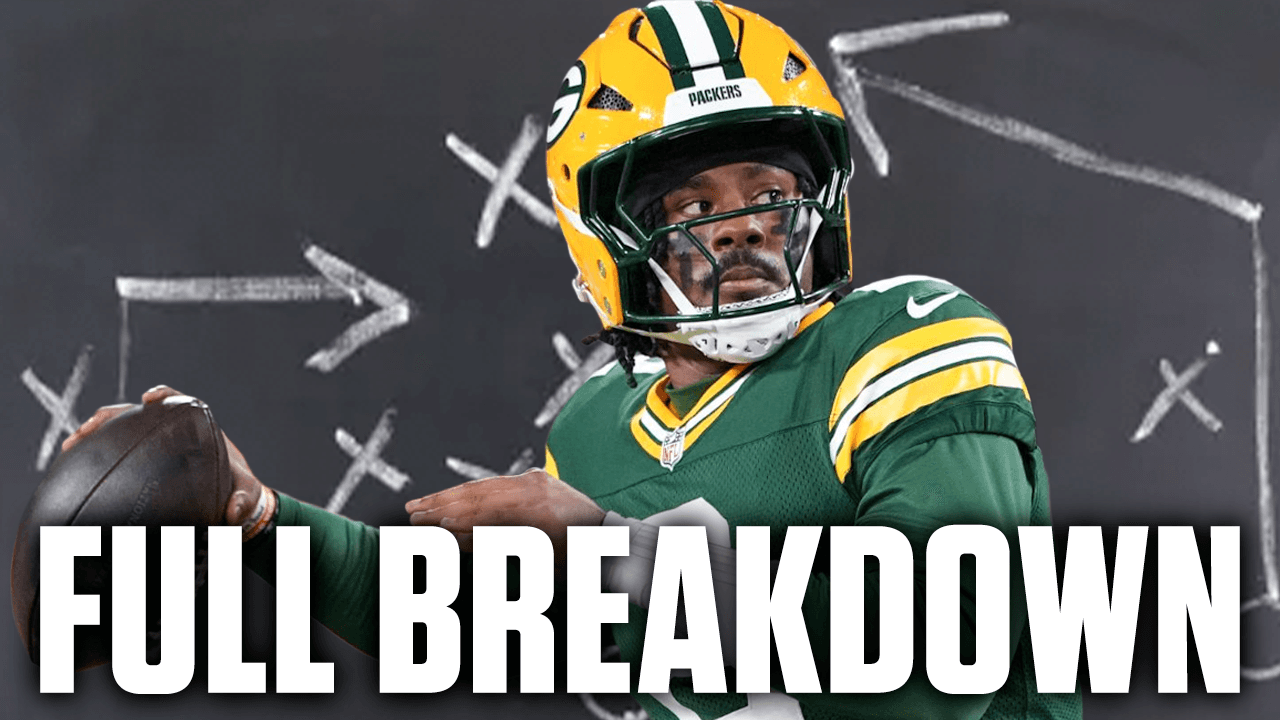
In Superflex dynasty leagues, perhaps the single most valuable asset is a quarterback with elite rushing ability. One such player may soon emerge in that tier, namely the Miami Dolphins’ Malik Willis. In a well-designed offense in Green Bay under Matt LaFleur, Willis impressed in spot starts. However, it’s an open question if he can translate that to a full-time starting role on a tanking Miami Dolphins team.
Those owners who take the chance on Willis may be rewarded with the latest Konami Code quarterback, but could just as easily become the proud owners of Arch Manning’s backup in one year.
Today, I'll take you through everything Malik Willis put on tape, discuss his strengths and weaknesses, and then advise on how much to offer for him.
Strengths
When discussing Malik Willis’ strengths as a player, it will be important to distinguish between strengths that matter for fantasy scoring vs traits that might indicate he’s genuinely a good football player and long-term starter. I have very few doubts that Willis will be a startable fantasy asset this year, if nothing else thanks to game script and rushing ability.
However, if he doesn’t play well enough, his fantasy production won’t do a thing to insulate his market value if the Dolphins move on from him.
Rushing Ability
While this is Willis’ most enticing trait for fantasy owners, it’s also the one that is most disconnected from whether he’s real-life good and likely to be a long-term starter. Having gotten that caveat out of the way, let’s dive right in.
Willis is comfortably in the upper echelon of rushing quarterbacks in the NFL. He’s not as agile as Lamar Jackson, as fast in a straight line as Justin Fields, or as sturdy as Josh Allen, but he’s got a good mix of all those traits.
Willis is plenty fast enough to run away from most linebackers, agile enough to sidestep would-be tacklers, including in the open field, and to my eye, he’s got a sturdy build. He’s not as wiry as Jayden Daniels, for example, and I didn’t see him take huge hits.
For fantasy purposes, I would argue that Willis is safely going to return starter value this year. There is always a risk the Dolphins shut him down later in the season to commit to a tank job, but he’s going to rush for lots of yards and chase some lopsided game scripts. The fantasy production will be there.
More important than the fantasy production, however, is how much his rushing ability contributes to his viability as a starter. Overall, I’d argue Willis picked his spots fairly well. He’s excellent at evading pressure, flashes a willingness to keep his eyes downfield when escaping the pocket, and tends to scramble when there is genuinely room to run. I didn’t really see any of the headless chicken type of scrambling that plagues many young quarterbacks.
We’ll talk about this more in his weaknesses section, but it’s not all sunshine and rainbows here. I do think he dropped his eyes before letting a play develop a bit more frequently than I would have liked, but it wasn’t so common as to scare me all the way off.
Overall, I think Willis picked good spots to run, and as a result, generated several explosive rushing plays. He’s also solid at evading pressure, including by escaping up through the A-gap and by side-stepping blitzers. There is a lot of good here, and it’s definitely a feather in his cap compared to pocket sloths.
Arm Talent
While Willis has plenty of arm strength, I always argue that arm talent goes beyond that. To me, “arm talent” means any combination of maintaining velocity with minimal windup or off imperfect platforms, throwing on the run, throwing against the grain of the play, and changing arm slots.
Every quarterback in the modern NFL can throw the ball 50+ yards in good conditions, but the NFL is all about imperfect conditions. To that end, Willis can easily make bucket throws deep outside the numbers with minimal discernible effort. This is a huge deal, as many quarterbacks lose touch and/or accuracy when they fully exert themselves.
Willis also excelled at throwing on the run, frequently creating explosive plays, including throwing against the grain. I didn’t really see Willis make plays by changing his arm slot, but I also didn’t see him get passes batted down, so it may just not have come up on such a small sample.
One negative here is that Willis sometimes trusts his arm too much and fades away when he feels pressure. In many of these cases, I think he could have instead stepped into the throw. This seems to indicate he’s come to rely on his arm talent as a bit of a crutch in these cases, and his deep accuracy really fades when he tries this type of throw.
Accuracy Down the Field
Willis was money when throwing 15+ yards downfield last season. This includes challenging tight windows in the deep intermediate parts of the field, throwing a seed up the seam, and making bucket throws over the top of the defense.
There were several cases where he not only completed a throw over the top of the defense, but also hit his receiver perfectly in stride. This is huge, as many quarterbacks leave plays on the field by underthrowing the wide receiver, allowing the defensive back to catch up and make a play.
Explosive Play Mentality
Pure accuracy down the field isn’t enough to generate explosive passing plays. It also takes a certain amount of confidence and playmaking ability to hunt explosive plays the way Willis does.
First, it behooves me to acknowledge that Matt LaFleur deserves an enormous amount of credit for the explosive plays generated by Willis. The route concepts he dialed up were extremely well-designed and were a perfect fit for Willis, providing him with frequent opportunities to push the ball downfield. The route concepts he dialed up were very effective at putting safeties in conflict and generating open throwing windows.
That being said, Willis absolutely has a playmaker’s mentality in the pocket, and he too deserves credit alongside LaFleur for how explosive the Packers’ offense was. He recognizes leverage and single-coverage looks, and in these situations he gives his receiver a chance by putting the ball in favorable spots. He’s also not afraid to challenge tight windows in the middle of the field, and to complete throws that require velocity. Finally, he’s not afraid to attempt bucket throws deep down the sideline.
Flashes Against the Blitz
As far as I can tell, Willis doesn’t panic when facing a blitz, and he also recognizes it early post-snap. However, he sometimes loses accuracy when he rushes his process to get the ball out in time. Overall, I like the potential I saw from Willis in these situations.
Once he’s identified the blitz, he has two options to avoid it. The first is by throwing hot and replacing the blitzing defender. This is a skill many quarterbacks struggle with, but on a small sample size Willis seems capable of mentally processing where and when to get the ball out. However, he also has some misses where he rushes his process and bounces the throw.
Willis was much more successful simply side-stepping blitzing defenders. His first two steps are very explosive, and he can get around the blitz and pick apart defenses that have too many numbers committed to the pass rush. This is notably something Jayden Daniels excelled at during his rookie season.
Flashes of Anticipation
While there are enough counterexamples that I can’t outright tell you this is a strength of his game, Willis does at least show he can hit throws with anticipation when he’s not just executing a shot play. This showed up in two main areas.
First, Willis showed very strong anticipation when he needed to read how a safety and corner were handing off vs carrying deep routes, and threw to the spot he knew the defense would vacate before the receiver was even really open.
Second, in third and medium situations, he was willing to hit the out-route with timing and accuracy, which can generate a lot of first downs in the NFL, especially when defensive backs have to respect his ability to throw over the top.
Flashes of Pocket Presence
Honestly, Willis’ pocket presence is more bad than good right now, and I’ll discuss it fully in the weaknesses section. I did want to point out that there are cases where he steps up in the pocket and delivers a nice throw under pressure. If he can build on this and execute more consistently, he’ll be extremely hard to defend.
Weaknesses
Pocket Presence
As I mentioned a moment before, it’s more bad than good here. By far Willis’ worst habit is his tendency to make fadeaway throws when his offensive line is bending but not breaking. He’s not exactly seeing ghosts, but when he notices the defense is making headway at the line of scrimmage, his thought process isn’t to deliver the ball with the last second of clean pocket available to him. Rather, he tends to lean backwards and lob a touch throw down the sideline. Jis accuracy leaves him when he fades like this, and the result is almost always an incomplete pass out of bounds.
In these situations, Willis also frequently drops his eyes and runs just a moment before his receiver has come open, and he’ll take a small gain rushing rather than letting the play develop and taking a big gain passing.
My major concern with Willis is that this could only get worse on a beleaguered Dolphins roster that may be in line for an awful season and that will be chasing games. He’s also less likely to benefit from quick answers schemed up by an elite offensive playcaller, and his receiver play will be much worse, too. Overall, it’s in his range of outcomes to lean into these bad habits so much that he’s not even functional anymore.
Short Accuracy
As is somewhat common for big-armed quarterbacks, Willis sometimes struggles to place the ball short. This frequently shows up as failing to maximize run-after-catch for his checkdowns and screen targets.
Additionally, Willis can sometimes leave the ball too far inside on out-breaking routes, which lets the defender break up the pass. On a larger sample, this could easily lead to interceptions and even pick-sixes.
Fumbled Snaps
Despite not playing very much, I counted three failed snaps for Willis last season. One was a fumble on fourth and short that essentially handed the Bears a win, and then there were two botched snaps against the Ravens.
Volume / Sample Size
While Willis overall did a very good job executing the offense that was called for him, there are also some indicators that Willis wasn’t trusted to operate like a typical NFL quarterback. When he was on the field, the offense was extremely heavy on read options, bootlegs, and designed shot plays. In Miami, Willis will need to show that the positive flashes from Green Bay have translated into success in obvious passing situations.
There is very little to go off of in terms of projecting Willis’ ability to run a more traditional NFL offense. Now that he’s no longer paired with an elite offensive head coach, he might get exposed in ways we never had the chance to see in Green Bay.
Situation
Now that we’ve discussed Willis as a player, let’s talk through the good and the bad in his situation, and how it affects his long-term projection as a starter.
Good
Endorsement from Jeff Hafley
Malik Willis likely signed with the Dolphins because he had an established relationship with the new Dolphins head coach, Jeff Hafley, who of course was the Packers’ defensive coordinator over the last two seasons. Hafley has seen much, much more of Willis than any other human being currently outside the Packers’ organization. Hundreds of snaps more. It’s clearly a positive indicator that he actually wanted Willis.
In six months, this could mean absolutely nothing, and Hafley absolutely could throw Willis under the bus. In any case, it would be a much more bearish indicator if Hafley saw fit to let Willis play against him.
Fit next to Devon Achane
The Dolphins’ offense better feature a heavy dose of read-option plays featuring Willis and Achane at the mesh point. These two should have a complementary effect on each other, and both will help each other be more efficient as a result. Defenders will be indecisive and hesitant defending Achane and Willis at the mesh point, since both are threats to generate an explosive play if anybody bites on a fake or overpursues.
Game Script
It’s never a good thing if your fantasy quarterback is on a bad team, but at least he can launder fantasy points for you by chasing the mess left behind by a terrible defense. Hey, it’s a silver lining.
Bad
Losing Matt LaFleur
I can’t stress enough how much I enjoyed watching the Packers’ route concepts while Willis was on the field. LaFleur dialed up a constant barrage of complementary routes that put defenders in conflict and created openings deep down the field.
If Willis has to switch to executing a less cohesive offense with worse receivers, the results could be atrocious. Compounding this issue is that Willis is paired with a defensive head coach, which means even if he plays for many years in Miami, he might lose the offensive coordinators who fit him best and constantly have to reset.
Receiving Weapons
Christian Watson and Romeo Doubs both made nice plays for Willis in his small sample size of games. Jayden Reed is no slouch either. While they lack a true #1 receiver, these guys stepped up for Willis and are at worst solid NFL players.
Going from that receiving corps to a depleted Dolphins unit that just lost Jaylen Waddle is a massive step back. Hopefully they draft somebody, but rookie wide receivers are at best a gamble regardless.
Low Value Insulation
On a bad team, it will be very hard for Willis to make the case to be the unquestioned starter going into 2027. Unless the Dolphins are much, much better than expected, it feels unlikely the Dolphins pass on what’s allegedly a good quarterback class. The best hope for Willis might be a winnable quarterback competition against a late first or early second round draft pick rather than simply being buried behind whoever gets picked at 1.01.
Conclusion
As far as my personal belief in Willis, I am bought in that he could not only execute but also enhance an offense in the Shanahan-McVay ilk, and not just in spot starts. However, I am not so confident he could be great in *any* offense, and I’m even less confident that his offense in Miami is going to be as well-designed as the one he just left behind in Green Bay.
Overall, I would be willing to offer a pick in the 1.07-1.09 range for Malik Willis, based on the following logic.
First, even if the deck is somewhat stacked against Willis here, his probability of hitting is likely comparable or only slightly worse than a late first-round dynasty rookie pick, particularly in what’s allegedly a weaker draft class.
Second, while his chances of sticking as a starting quarterback may be questionable, his fantasy output in 2026 should far exceed what you expect from a late first-round pick. It is well within Willis’ range of outcomes to score like a QB1 even if he’s playing real-life bad. Consider how much you would pay at the trade deadline for an aging quarterback who was scoring as a low-end QB1, and you’re pretty close to Willis’ one-year trade value.
Third, his upside is higher than most late first-round dynasty rookie picks. It’s in his range of outcomes to be one of the Konami Code quarterbacks.