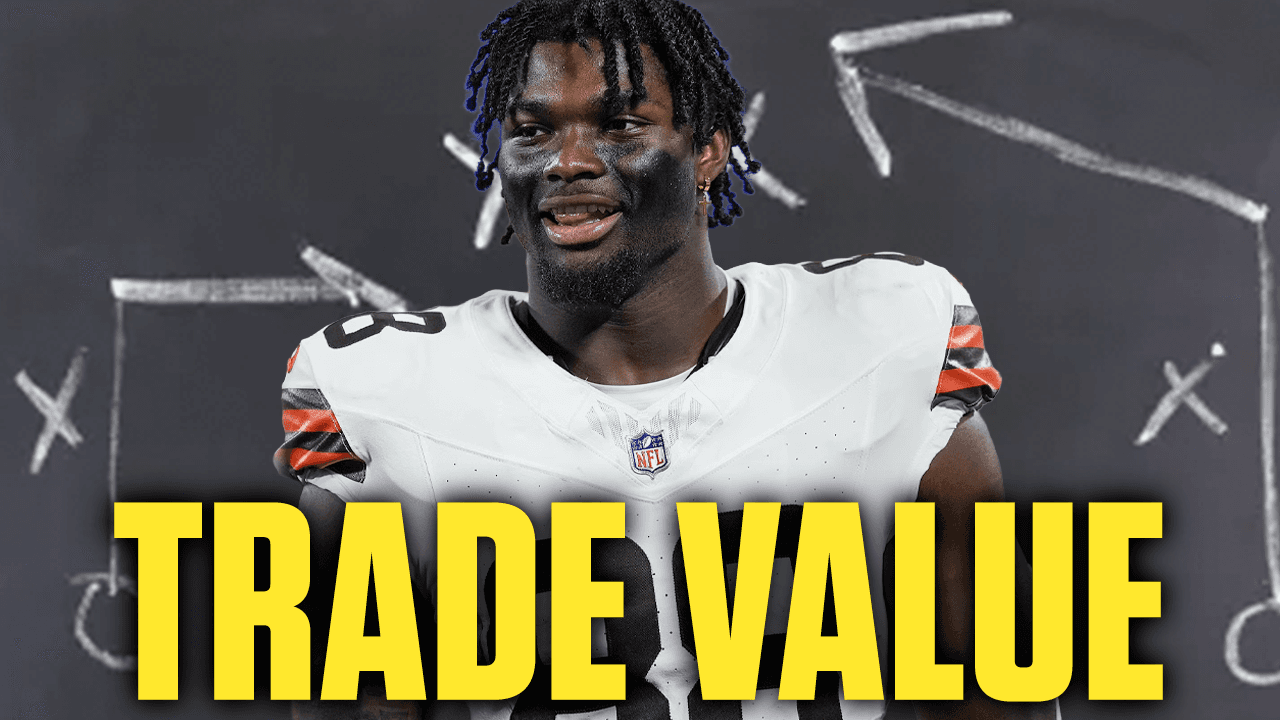
On the heels of a successful rookie season, and now with the news that David Njoku won’t be returning to the Browns, Harold Fannin Jr’s stock is rising quickly. Should you pay up?
Welcome back to my Rookie Season Reviews series. Today, I’ll go over the good and the bad from Fannin’s rookie season, and project what dynasty owners can expect from the Browns’ newly minted TE1 going forward.
Usage
The day he drafted Harold Fannin Jr, Browns’ general manager Andrew Berry highlighted the young tight end’s versatility, and that absolutely translated during Fannin’s rookie season. The Browns lined him up all over the field, including out wide, in the slot, adjacent to a blocking tight end on the line of scrimmage, and even in the backfield.
As far as passing game usage, Fannin was frequently deployed as a safety valve underneath zones or to chip and release. However, he was also the beneficiary of a couple of designed catch-and-run opportunities each game, with Fannin blocking and then releasing and receiving a short pass with room to run.
Crucially for fantasy, Fannin was also activated in the intermediate parts of the field, particularly during the second half of the season, and he even had a few shot plays called for him. He notably scored a couple of touchdowns on plays where he ran a route out of the backfield, finding himself wide open for easy touchdown catches.
One important note is that Fannin was rarely deploying in-line, with David Njoku taking that responsibility. Even in Fannin’s last game against the Steelers, which Njoku missed, a blocking tight end was preferred for this role rather than Fannin. This might indicate Fannin will remain more of an F tight end than a true full-service starting Y tight end, even with Njoku off the roster.
Overall, Fannin ran plenty of routes his rookie year, en route to a 76% snap share and 441 routes run, good for 11th among NFL tight ends. With some seriously intriguing usage for fantasy purposes, let’s break down what Fannin did with these opportunities and whether we can expect more going forward.
Strengths
Route running
Harold Fannin’s best trait is the crispness of his cuts on horizontally breaking routes, particularly when matched up against linebackers. On both in-breakers and out-breakers, Fannin gets separation easily against bigger defenders, more so with crisp change of direction than with pure explosiveness.
Fannin was also effective on dig routes, and he was really hard to cover if defenders first had to carry him vertically before he got into his break. In these situations, Fannin would snap his route off really well and easily gain the initiative.
One important caveat is that Fannin’s route running was much, much less effective against defensive backs. Even as a fairly crisp route runner, defensive backs are just a cut above when it comes to reactive athleticism and fluidity.
Early in the season, this went really poorly for him. The Browns lined him up out wide and in the slot, frankly more often than I thought was helpful, and corners absolutely blanketed him. Later in the season, the Browns started deploying him in tighter alignments, and he benefited immensely.
Overall, the Browns didn’t do the best job of dictating matchups such that Fannin was lining up against linebackers. It’s not entirely clear to me if this was on the coaches, or if it’s simply because Fannin is neither the blocker nor the athlete to punish defenses. In any case, there is some latent upside in the eventTodd Monken is noticeably better than Kevin Stefanski at dictating the matchups to favor Fannin.
Hands
Fannin shows good fundamentals, catching with his hands away from his frame. He also came down with the occasional tough catch to make a big play for his quarterback, and he tracks the ball very well when deep shots are dialed up for him.
However, when I go over his weaknesses, I will have to mention a couple of caveats related to his reliability.
Tackle breaking
Fannin broke a ton of tackles in his rookie year, forcing defenses to gang-tackle him. It really takes a village to bring him down. Behind his superb broken tackle rate, Fannin racked up an impressive 352 yards after catch, good for seventh among NFL tight ends, despite running fewer routes than every tight end above him.
While he isn’t the most explosive athlete, his tenacious running style does earn him the occasional first down and one or two extra fantasy points per game.
Playmaking
This category is hard to quantify, but Fannin just had a knack for making big plays during his rookie year. Whether it was working a scramble drill with Joe Flacco, making tough catches for Shedeur Sanders, or rumbling for a first down he had no business converting, Fannin was a refreshing change of pace from the rest of the Browns' mistake-prone, beleaguered receiving corps.
Explosiveness
I don’t have the faintest clue what happened during the Browns’ bye, but Fannin moved like a different caliber of athlete during the second half of the season. Going into the Browns’ week 10 matchup with the Jets, Fannin looked the same as he did in college. Like always, he was incredibly stiff but weirdly effective.
Starting in week 10, Fannin looked more fluid and explosive than I had ever seen him. He got up the seam noticeably more quickly, and his acceleration snuck up on linebackers who failed to carry him vertically, leading to chunk plays.
Previously, I would have told you Fannin was a mediocre athlete among the “move” tight ends, but now he’s squarely above average, even among this more agile subset of NFL tight ends.
Youth
Fannin will be 22 years old during his entire sophomore season. It’s truly impressive for a 21-year-old rookie to make an impact at the tight end position, and Fannin’s best football is clearly ahead of him. Considering he moved noticeably better later in the season, there is a chance he unlocks a bit more athletic upside with a full offseason in the NFL. Gaining some strength wouldn’t hurt either if he gets some extra responsibility in-line.
Weaknesses
Tweener
I mentioned previously that I didn’t think the Browns did a good job of getting Fannin matched up against linebackers. Well, part of that is on Fannin. In order to become a mismatch weapon at the NFL level, Fannin needs to punish teams with strength if they deploy defensive backs against him.
Currently, Fannin is an easy cover for corners and safeties. He hasn’t quite figured out how to use his size advantage to win with physicality and leverage. To be fair, corners got extremely grabby against him, but if he isn’t drawing flags and he isn’t winning the rep, then he needs to put the excuses aside and win the rep.
At the moment, Fannin also isn’t a good enough blocker to force defenses to go heavy, which means he isn’t changing the math for defensive coordinators. He frankly doesn’t have the size and strength of a true full-service Y tight end, so he doesn’t really project to become that type of player either.
While this all sounds pretty negative, the cat-and-mouse game between offensive playcallers and defensive coordinators is much bigger than a single rookie tight end. Regardless of how good a blocker Fannin is, the Browns didn’t have a credible run game all year. Both their offensive line and the design of their run game were abysmal, so it’s quite possible teams will have to defend the Browns with heavier personnel groupings in future years, leading to an increase in favorable matchups for Fannin.
Blocking
Fannin’s effort while blocking was impressive, but he was pretty easy for bigger defenders to toss aside. The Browns likewise shielded Fannin from the toughest blocking assignments, preferring Njoku or depth blocking tight ends for those roles.
This part of Fannin’s game will be a huge storyline going into next season, as it appears David Njoku will be leaving Cleveland. Whether Fannin can earn the tougher blocking assignments will go a long way in determining where his snap share maxes out. For now, he’s more of an F tight end. This type of player can have good one-off seasons, but they’re almost never the bread and butter of their offense.
Hands (Reliability)
Fannin didn’t have a big issue with drops, but he did leave a couple of should-be chunk plays on the field. He was credited with 5 drops by PFF, so the overall drop numbers aren’t out of control.
More concerning however was that Fannin struggled mightily holding on to the ball through contact. These plays can’t technically be charted as drops, but they hurt an offense just the same.
As a smaller tight end, Fannin doesn’t box out well, and his leverage is not very reliable to throw into. Even when the defender didn’t deflect the pass, Fannin still struggled to finish the play and hold on to the ball and survive the ground.
As a primarily pass-catching tight end, it’s a very big deal if throws into his leverage aren’t reliable. It limits both the PPR floor and ceiling for Fannin, and it could affect his trust with whoever ends up playing quarterback for the Browns.
Whereas many tight ends function as safety blankets for their quarterbacks, and as an occasional easy button against zone coverage, Fannin is in the unenviable position of trying to become one of his team’s featured pass catchers despite not being too reliable over the middle of the field.
Getting through traffic on misdirection plays
This is an extremely specific criticism, but there were a couple too many designed run-after-catch plays for Fannin where he fell behind schedule picking through traffic. A lot of these play calls used misdirection, which meant Fannin needed to look like a blocker while letting the play develop.
On a surprising number of these plays, Fannin got swallowed up trying to navigate through the traffic, leaving his quarterback with nowhere to go with the ball. Other times he even stumbled while the ball was in the air, leading to incompletions that could easily have been interceptions.
Conclusion
Overall, Fannin is an extremely fun watch, and a breath of fresh air as somebody who actually makes plays for an otherwise unwatchable Cleveland Browns offense.
However, my advice for Fannin owners is to tier up from him, particularly as his trade value increases with news that Njoku is leaving.
As far as I can tell, the best version of the Browns offense does not feature Harold Fannin as a top-two option. If he generated more mismatches against smaller coverage defenders, or if he was more reliable over the middle of the field, I might be able to move past concerns over the positional value of a pure “move” tight end. As things stand, he should be an added element that stresses defenses, but not a featured option.
To prove me wrong, Fannin would need to step up in the run game in 11-personnel. But to this point, his usage has been as a jumbo receiver who is shielded from in-line blocking assignments. With Njoku leaving, there is a huge opportunity for Fannin to take on the mantle as the Browns’ full-service TE1. Whether he actually accomplishes this is another matter entirely.