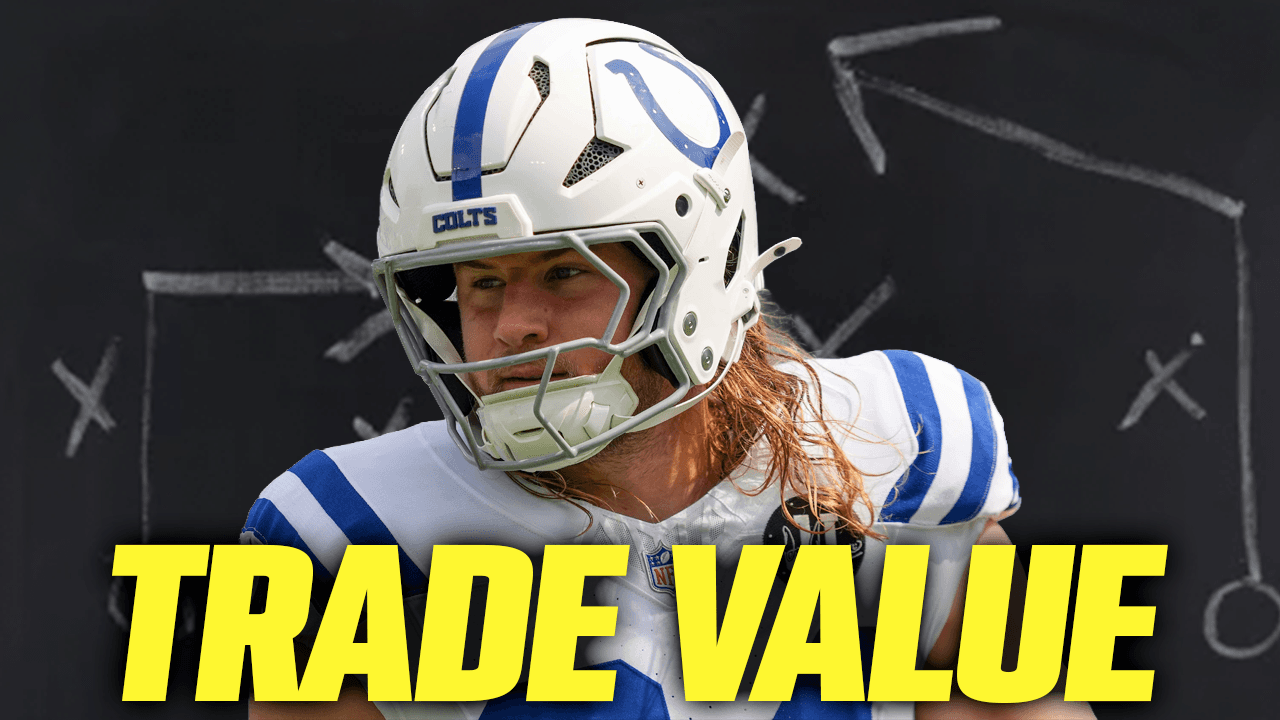
If Colston Loveland’s rookie season started slow but ended with a bang, Tyler Warren’s was the complete opposite. Warren roared out of the gates as a high-usage TE1, but then ended his season with a bit of a whimper, through no fault of his own, as the Colts collapsed down the stretch due to Daniel Jones’ season-ending Achilles injury.
As the Colts try to pick up the pieces for next season, it behooves dynasty owners to put Warren’s performance into context. What can we project for Warren going forward, and how much should we value that for dynasty fantasy football? His rookie season is now behind him, and our job is to determine what to expect from Warren going forward.
Why Tyler Warren is already a good starting tight end
The tight end position in the NFL is extremely scarce. There are maybe three players in any given year who are truly featured in their offenses, and then there is everybody else. I argue that Tyler Warren is perhaps the very best fantasy asset in the “everybody else” tier.
Usage
From quite literally the first snap of his career, Tyler Warren enjoyed outstanding designed usage. He was given frequent catch-and-run opportunities with Warren releasing from the backfield with green grass in front of him. He was also the recipient of a few screen passes.
Head coach Shane Steichen didn’t stop at designing short catch-and-run plays for Warren either. He also called semi-frequent deep shots that involved the wide receivers running clear-out routes, which carved out space for Warren to come open 20+ yards downfield on wheel routes and slow-developing vertical routes.
The Colts made a point to involve Warren early and often in their playcalling, especially in the scripted drives at the beginning of games. Later on in games, Warren was frequently used as a safety valve underneath, and occasionally as a seam stretcher.
Efficiency
Warren generally rewarded the Colts for this usage, serving as a very effective option in a diverse and balanced offense. I would argue he wasn’t featured as a first option so much as he was one of many tools in the toolbox.
While his drop rate varies greatly by source, to my eye he has very reliable hands on routine balls, and he could have been activated a bit more in contested situations or with throws into his leverage. While he has solid hands, I will say he struggled a bit to bring in the tough balls those times that Daniel Jones happened to place them poorly. This could quickly revert, as Warren constantly bailed out Drew Allar with spectacular catches at the college level.
Warren’s run after catch is likewise above average but not elite. Sometimes he wins with strength and pure willpower, but other times he can make defenders overrun him to the sideline before cutting back into a pocket of space. I’d argue he also has good vision as a ball carrier.
At one of the most volatile and difficult positions in football, there is a lot of value in having a guy who is both above average across the board and versatile, and who the offense can activate in any number of ways. The key with Warren is that he moves well enough to earn targets both short and deep, and that he blocks just well enough to support the run game.
Snap Share
Tyler Warren consistently received snap shares above 80%, even eclipsing 90% twice on the season. His competition for snaps is frankly nonexistent, with Mo Alie-Cox sometimes getting onto the field as a blocking tight end.
Adequate Blocking
Tyler Warren doesn’t have the best blocking technique or pad level, but the “want to” aspect of his game was there. Often deployed as an H-back, he was frequently asked to run across the back of the formation and seal, preventing the backside edge rusher from making a play on the ball carrier. He was quite effective in this regard, albeit in an easier assignment than being deployed in-line.
When lined up against smaller players, particularly when he was in the slot, Warren took to the assignment with gusto and really drove the overmatched defender back.
I say Warren’s blocking is merely adequate because the Colts clearly omitted to ask Warren to block in-line, preferring their other tight ends for that duty. Those times he needed to get some push against a defensive lineman, he was pretty ineffective, and this often resulted in stuffed runs.
For fantasy purposes, Warren’s blocking is good enough to keep him on the field, and it mostly checks the box for dynasty owners, but it’s not good enough to banish his blocking-focused teammates into obscurity.
Usage Downside
While Warren was generally a safe fantasy asset, he did have a floor game against the Pittsburgh Steelers with only 26 receiving yards. In this game, Warren was frequently used to chip and release against T.J. Watt, which meant he wasn’t as involved running routes downfield. This makes complete football sense for the Colts, but it’s a minor detail to worry about for fantasy owners.
Why Tyler Warren is not quite one of the elite, rare game-changers
While Tyler Warren is clearly a very good tight end, both for real life and for fantasy, I may as well discuss why exactly he’s still heading up the second tier of tight ends, and not joining Brock Bowers and Trey McBride in the S tier.
Route-Running / Movement Ability
I mentioned previously that Tyler Warren moves well enough to justify diverse usage, both on short run-after-catch plays and also on deeper concepts. However, his movement ability does not rise to the level of the mismatch weapon everybody is looking for at tight end.
Against linebackers, Warren isn’t quite fast enough to run away from them. There are times Daniel Jones’ eyes stay on him, waiting for him to run away from a linebacker on a crosser, but he simply doesn’t create the separation. Likewise, defenders can carry him up the seam and to the pylon in man coverage situations.
As a route runner, Warren’s cuts are somewhat clunky. They’re rounded and gain too much depth, which drifts him towards defenders at the next level of the secondary. His first couple of steps out of his break are also not that explosive. Together, these weaknesses mean it’s far too easy for zone defenders to click and close on him.
Zone Beating
Frankly, I don’t like Tyler Warren’s instincts against zone coverage. He stops his feet when he decides to sit (if he even decides to sit), and doesn’t have a good sense of how to move his feet and make minor adjustments to maintain his cushion from nearby coverage defenders.
For a tall, strong tight end with good hands, throws into his leverage should be a consistent “easy” button against zone coverage. To this point, that’s been a major missed opportunity in Warren’s game.
Balanced Offense
The Colts’ offense was extremely balanced and well-designed last year. While Warren got his share of designed targets, and they were effective, I can’t look you in the eye and tell you the Colts would become a better football team by scrapping some part of the playbook in favor of more Warren plays.
Michael Pittman and Josh Downs are both good receivers, Alec Pierce is frankly really good at his specific role, and hell I even liked the Ashton Dulin plays in the playbook. That’s all before I even mention it behooves the Colts to be run-heavy with Jonathan Taylor playing at a high level.
Going into his rookie season, I had argued that Warren had a good chance at being the number one option in his pass-catching corps. After watching an entire season of the Colts’ offense, I feel strongly that their best path forward is to remain balanced and diverse. There isn’t a player on this roster who would make the Colts more efficient by having the ball forced to them.
The exact opposite is happening over in Chicago, where going into the season I argued it would be incredibly hard for Colston Loveland to become a top-two option in his offense. Fast forward one year, and there are continued bad vibes surrounding D.J. Moore, to go along with a season-ending lackadaisical route. Meanwhile, Rome Odunze is concerningly inconsistent for a second straight year. At this point, I would argue Colston Loveland is closer to being the featured option in his offense than Warren is.
Usage (Downside)
On his college tape, my favorite aspect of Warren’s route running was how he used physicality to gain separation. He was very good at stemming directly into a coverage defender, disrupting them by initiating contact, and then breaking to the sideline.
There was one notable instance against the Broncos where Warren used this exact technique to earn a reception, against Pat Surtain of all people.
However, on the whole, this was an under-utilized part of his game in Indianapolis. When not running plays designed for him, Warren was often used as a safety valve in the flat or into the short middle of the field. He was very rarely asked to win on his own in the intermediate areas. This is a major source of fantasy production that Warren doesn’t have much access to, whereas the elite-elite guys are winning in this area all the time.
Chemistry with Daniel Jones
My other favorite part of Tyler Warren’s college tape was his knack for making touch catches 1v1 with a defender draped all over him. There were times I would audibly chuckle or roll my eyes at how he always seemed to come down with the ball.
Alas, that ability to make tough plays did not really show up in the NFL, at least not so far. To some extent, this was a trust issue between Warren and his quarterback. Daniel Jones simply did not throw 50/50 balls to Warren deep down the field, something Drew Allar learned was practically a high percentage throw at Penn State. Jones was likewise shy to throw tight window balls into Tyler Warren’s leverage when he was boxing out a defender.
While it’s tempting to put all the blame on Jones here, there were also times Warren didn’t reward his trust, with Warren failing to hold on to the football through contact. This area is the single greatest opportunity for untapped upside in Warren’s game going into next season.
Warren and Jones also never synced up on the scramble drill, which is in stark contrast to the blooming symbiosis between Caleb Williams and Colston Loveland. Some of this is that Daniel Jones is less of an improvisational playmaker than Williams (go figure), but some of it is also that Warren isn’t a sudden or explosive enough mover to snap off his route and get away from his defender late in the play.
Rushing Usage
Coming into his rookie year, I speculated that Tyler Warren had an upside tail as the Colts’ designated tush push player. After all, he was activated in a variety of ways in college, including as a rusher in short-yardage situations.
With the Colts, Warren received a grand total of six rushing touches, all on 3rd or 4th down and with three or fewer yards to gain. The result was a 50% success rate, one touchdown, and one fumbled snap. Both in terms of volume and in terms of success, this part of Warren’s game never came to be.
With the tush push likely going extinct soon, the dream of Warren racking up rushing touchdowns is likely gone. There remains upside tail where Jones’ recovery from an Achilles injury limits his rushing workload, and that short-yardage rushing goes directly to Warren. On a team with Jonathan Taylor, I’m not holding my breath.
Conclusion
Tyler Warren played like an above-average TE1 from the moment he stepped onto the field his rookie season, and will likely make a couple of Pro Bowls over a long career. He’s well-rounded and reliable, with some untapped upside as a ball winner in tight windows and contested situations.
However, we should manage our expectations for Warren’s value as a dynasty asset. I don’t project Tyler Warren to take the next step and become one of those rare game-changing TE1s, such as prime Travis Kelce, Mark Andrews, and George Kittle, or current Trey McBride and Brock Bowers.
As far as where that leaves dynasty owners, current Tyler Warren owners can be content that they have a really good long-term starter. There is no sense of urgency whatsoever to sell high on him, or to package him up into another tight end, which is such a volatile position anyway.
If you’re an owner considering acquiring Warren, I would advise against it based on the presumed price. I don’t see him becoming one of those players who propels your fantasy team to a title, but you would almost certainly have to pay up as if he is.
While last week I suggested Colston Loveland could develop into that guy and reward your gamble, I don’t believe the same will happen with Warren. You’re better off taking your major swings at the more premium positions, even in TE premium leagues.
Let’s say, for argument’s sake, you have a major need at tight end, and you’re contending, and the Warren owner in your league is reasonable about the price. You can feel free to offer a mid-to-early first-round pick plus other picks or prospects to sweeten the deal.