Last week, I began a Build A Prospect series for the 2026 NFL Draft, starting with quarterbacks. This week, we’ll be moving along to running backs.
This is how this will work: there are seven running back attributes I’ve selected (speed, shiftiness, vision, power, contact balance, receiving, pass blocking). The goal is to build the best possible running back using one prospect for each of these attributes.
Once we use a prospect, he cannot be used again throughout the rest of the attributes, so I must choose wisely. Let’s get started!
Speed
Jadarian Price - Notre Dame
Speed isn’t the most important trait for a running back, but it is important. The ability to hit that game-changing gear and provide an explosive play can flip a game on its head. I don’t think anyone in this class finds the top gear that Notre Dame Fighting Irish running back Jadarian Price does.
To take an analytical look at this, let’s look at PFF’s BAY% (breakaway percentage), which analyzes how much of a running back’s production came from 15+ yard runs. For example, if a running back had 1,000 rushing yards and 400 of them came from 15+ yard runs, that running back would have a BAY% of 40%.
In 2024, the NFL leader in BAY% (min. 50 rushing attempts) was Cleveland’s Jerome Ford at 45.1%. Price, though, has an astounding career BAY% of 56.2%, 62.8% in 2025 so far.
But I’m more focused on the tape, and not only does Price get to his top speed quickly, nobody can catch him once he does. He finds that next gear at the second level and turns many 10 to 15 yard gains into 30+ yard house calls.
Shiftiness
Jahiem White - West Virginia
Shiftiness is something I care about in a running back because the ability to make people miss, especially in tight areas, can turn 3-yard gains into 10+ yard gains. I think West Virginia Mountaineers running back Jahiem White showcased this ability the best.
I must preface this by acknowledging that White did suffer a season ending knee injury in West Virginia’s week two matchup against the Ohio Bobcats, so he may not even enter this draft. However, I was very high on him in the summer as he was my RB2 and my 19th overall player, so I included him.
White’s ability to change direction on a dime without losing any speed was something that popped off his tape. It didn’t matter if it was in the open field or in a muddy running lane; he was likely making the first man miss in rather embarrassing fashion (for the defender).
Hopefully he can make a full recovery and get back to where he was athletically before the injury. If he can, I think he’d comfortably be the shiftiest back in this class.
Vision
Jeremiyah Love - Notre Dame
Vision is the trait I consider to be the most important for a running back to have. If you have trouble reading block leverage and unnecessarily bouncing runs, then it’s really hard for your other traits to make up for that. Notre Dame Fighting Irish running back Jeremiyah Love has the best vision of any running back I’ve watched for the 2026 NFL Draft.
The way Love anticipates holes to run opening up is a thing of beauty to watch, seemingly always making the right decision. His shiftiness allows him to be more creative behind the line of scrimmage as well.
It’s been a bit of a rough start statistically for him in 2025 as Notre Dame’s new offensive line continues to gel. However, I’d expect him to settle in and be the Doak Walker Award candidate we all know he is.

Tweet via @PFF_College on X
Power
Darius Taylor - Minnesota
Possessing the ability to run with power at the next level only makes a running back more valuable. I haven’t seen anyone in the 2026 NFL Draft class run with quite as much power as Minnesota Golden Gophers running back Darius Taylor.
There’s a run that sticks out from his 2024 tape against USC that magnifies this, where he sent a poor USC safety airborn five yards back after making contact with him. Taylor just flat out runs hard on every carry.
Taylor has been a “my guy” so far for me in the process, as he was my RB4 and my 61st overall player. I expect him to continue to run like a bull in a china shop.
He did have a leg injury scare against Northwestern State in week two that held him out of the Gophers week three game against Cal, but it doesn’t seem to be anything long term. Hopefully he can put together a healthy 2025 past this.

Tweet via @PFF_College on X
Contact Balance
Jonah Coleman - Washington
Contact balance is key to getting yards after contact. Whether it’s through arm tackles or just defenders simply not being able to bring him down, no one in this class has the contact balance that Washington Huskies running back Jonah Coleman possesses.
Coleman is stout and compact at 5’9” and 220 pounds, and looks that weight on tape as well. His low center of gravity helps him get under the pads of defenders, and his lower-half strength/leg drive allows him to fight through for extra yardage.
Coleman is also a plus athlete at his size, allowing him to generate even more forward momentum to stay on his feet. He’s already amassed 228 yards after contact through two games in 2025, and has a career average of 4.47 yards after contact per attempt.
Receiving
Desmond Reid - Pittsburgh
The ability to be an addition to the passing game can give a running back extra value and create mismatches against linebackers. Pittsburgh Panthers’ running back Desmond Reid is, by a considerable margin, the best receiving back in this class.
In 32 career games at the college level, Reid has totaled 100 receptions for 1,145 yards and five touchdowns, pretty ridiculous marks for a running back. Reid transferred from Western Carolina to Pittsburgh before the 2024 season, and had modest receiving production for the Catamounts, but exploded in the receiving game for the Panthers in 2024.
Reid’s 2024 saw him catch 52 passes for 579 yards and four touchdowns. This included three 100+ yard receiving games, those being against Cincinnati, North Carolina, and Clemson. Against Cincinnati, he also ran for 148 yards, logging a rare 100+ rushing 100+ receiving game.
On the film, though, he runs every route you could expect a receiving back to run. Texas routes, wheel routes, “M” routes, seam routes, corner routes, seam-post routes, he literally runs it all. His suddenness and quickness allow him to create immense separation in his routes.
It may be hard for him to stick in the NFL at his listed size of 5’8” and 175 pounds. A couple of the NFL comps I had for him in the summer were Jerick McKinnon and Tarik Cohen, both of who have had immense receiving production as pros.
Pass Blocking
Nick Singleton - Penn State
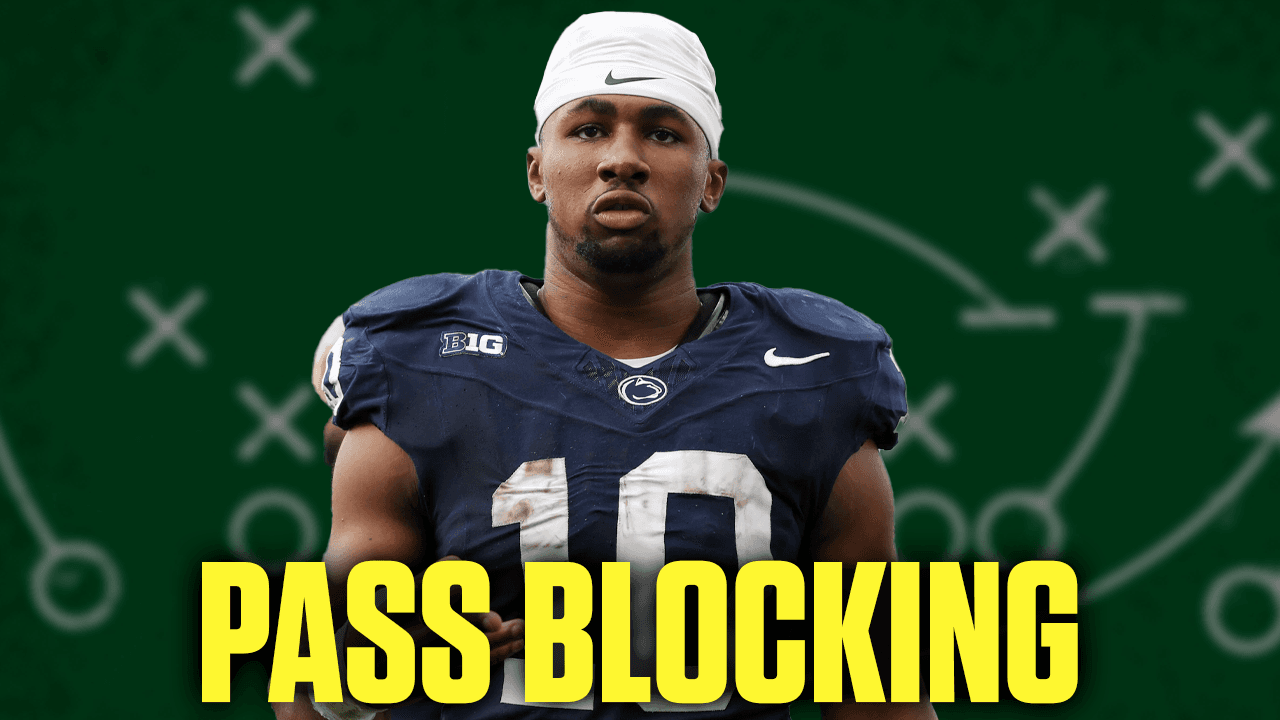
Being a reliable pass protector at the running back position is imperative to being on the field in third down situations. There are some good pass protecting running backs in this class, but I see Penn State Nittany Lions running back Nick Singleton as the best in this category.
Singleton is compactly built and doesn’t have issues moving laterally. This gives him the ability to slide across the formation to pick up blitzes as well as stalemate stronger defenders.
I thought his pass protection was productive in every game I watched of him, but he was on another level vs Ohio State in 2024. Whether it was Cody Simon, Sonny Styles, or Lathan Ransom trying to blitz and affect Drew Allar, Singleton stymied every single one of them.
Final Thoughts
This Build A Prospect series is going to be a really fun series to dive into over the course of the college football season as we lead up to the 2026 NFL Draft. I hope you enjoyed the running back iteration of this article series, and make sure to tune back in for the wide receiver iteration next week.